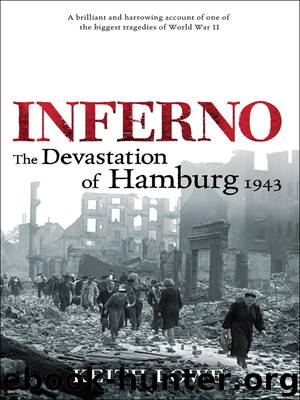
Inferno by Keith Lowe
Author:Keith Lowe
Language: eng
Format: epub
Publisher: Penguin Books Ltd
Published: 2007-08-29T04:00:00+00:00
17. The ‘Terror of Hamburg’
A stream of haggard, terrified refugees flowed into the neighbouring provinces.
In every large town people said: ‘What happened to Hamburg yesterday
can happen to us tomorrow.’
Luftwaffe General Adolf Galland1
The events of 27/28 July 1943 shook the Nazi hierarchy to its core. Writing in his diary a few days later, Josef Goebbels called the disaster ‘the greatest crisis of the war’.2 For once, the normally resourceful propaganda minister seemed at a loss for what to do.
A city of a million inhabitants has been destroyed in a manner unparalleled in history. We are faced with problems that are almost impossible of solution. Food must be found for this population of a million. Shelter must be secured. The people must be evacuated as fast as possible. They must be given clothing. In short, we are facing problems there of which we had no conception even a few weeks ago.3
Many other key figures in the Nazi establishment were just as shaken. Albert Speer, the Minister of Armaments and War Production, told Hitler that if the British managed to attack another six German towns on the same scale then armaments production would be brought to a halt.4 Erhard Milch, the State Secretary for Air, went further: ‘It’s much blacker than Speer paints it,’ he told the members of his ministry. ‘If we get just five or six more attacks like these on Hamburg, the German people will just lay down their tools, however great their willpower.’5
The crisis of confidence became so bad that Hitler was forced to take action to avert a collapse of morale in the Party. A few days after the catastrophe, he instructed Goebbels to speak to an assembly of ministers and gauleiters to ‘inject some concrete into them’. Ever faithful to his master, Goebbels did as he was told. It was a tense meeting. During the discussion, Milch repeatedly interrupted Goebbels with the almost treasonable outcry, ‘We have lost the war! Finally lost the war!’ The propaganda minister had to appeal to his honour as an officer to quieten him.6
While those around him were in deep shock at the scale of the disaster, Hitler appeared to react in much the same way as he did to all such catastrophes: by remaining in denial. To Speer’s announcement that further British attacks might halt German arms production, he simply said, ‘You’ll straighten all that out again.’ Neither was he sympathetic to the victims of the firestorm. When Hamburg’s gauleiter, Karl Kaufmann, repeatedly telegraphed him, begging him to visit the stricken city, Hitler steadfastly refused. When Kaufmann asked him at least to receive a delegation of the heroic rescue crews, Hitler refused that too. He was simply not interested in Hamburg, or the fate of its people.7
* * *
On the other side of the North Sea, the mood was precisely the opposite of that in Germany. While the Nazis imposed a virtual news freeze on all but the most general reports of the firestorm, the British and American authorities were quick to announce their success to the international press.
Download
This site does not store any files on its server. We only index and link to content provided by other sites. Please contact the content providers to delete copyright contents if any and email us, we'll remove relevant links or contents immediately.
| Africa | Americas |
| Arctic & Antarctica | Asia |
| Australia & Oceania | Europe |
| Middle East | Russia |
| United States | World |
| Ancient Civilizations | Military |
| Historical Study & Educational Resources |
The Radium Girls by Kate Moore(12089)
100 Deadly Skills by Clint Emerson(4968)
Rise and Kill First by Ronen Bergman(4833)
The Templars by Dan Jones(4730)
The Doomsday Machine by Daniel Ellsberg(4538)
The Rape of Nanking by Iris Chang(4255)
Killing England by Bill O'Reilly(4041)
Stalin by Stephen Kotkin(4002)
Hitler in Los Angeles by Steven J. Ross(3974)
12 Strong by Doug Stanton(3574)
Hitler's Monsters by Eric Kurlander(3382)
Blood and Sand by Alex Von Tunzelmann(3237)
The Code Book by Simon Singh(3235)
Darkest Hour by Anthony McCarten(3161)
The Art of War Visualized by Jessica Hagy(3041)
Hitler's Flying Saucers: A Guide to German Flying Discs of the Second World War by Stevens Henry(2777)
Babylon's Ark by Lawrence Anthony(2716)
Tobruk by Peter Fitzsimons(2558)
The Second World Wars by Victor Davis Hanson(2553)
